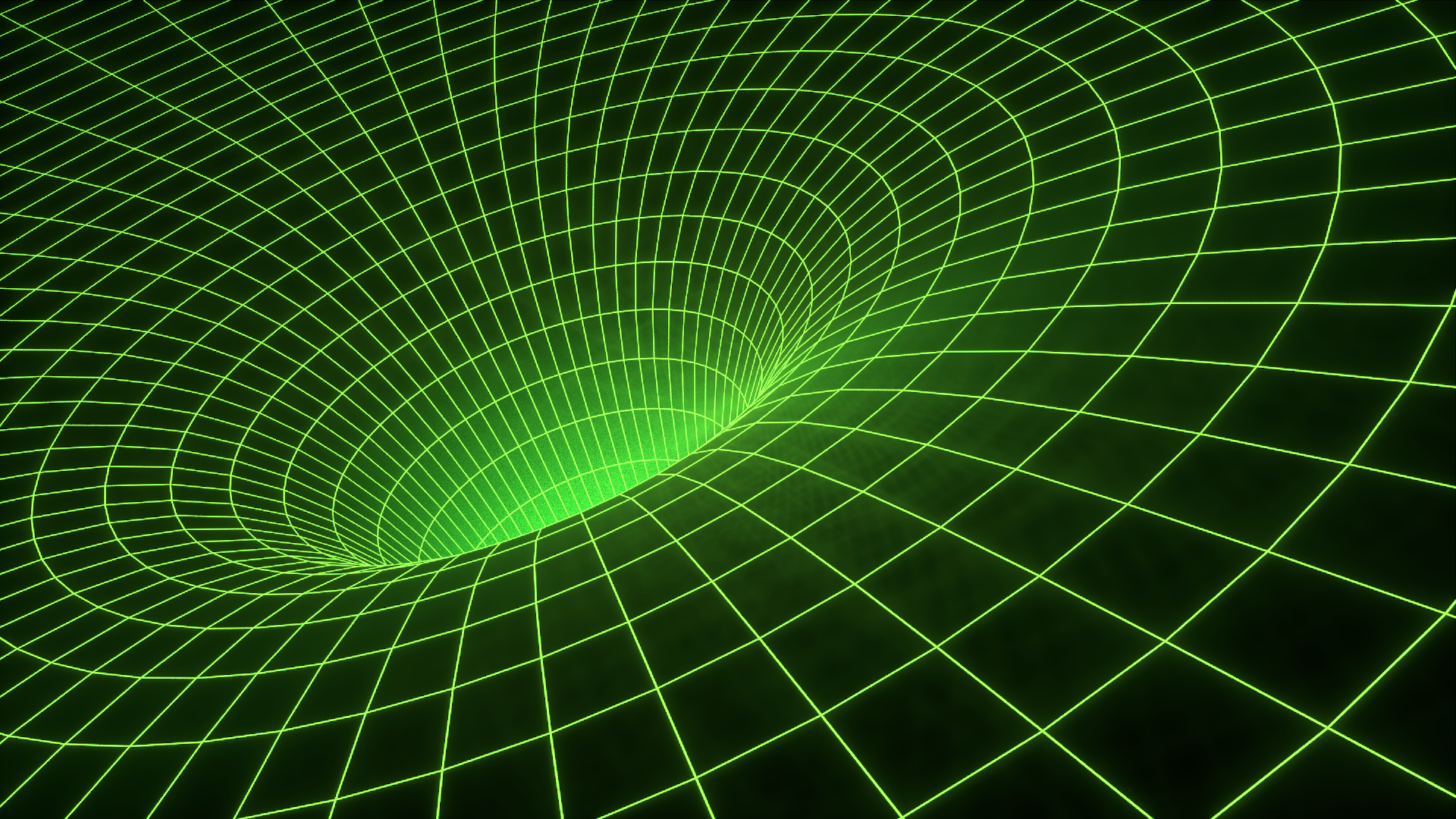
Imagine opening your front door...
...and instead of seeing your front yard, you step out onto the surface of Mars.
Sounds impossible, right?
That's the basic idea behind one of the most fascinating concepts in modern physics: the wormhole.
Wormholes have appeared in countless science fiction stories, movies, and TV shows. They're often used as cosmic shortcuts that allow spaceships to cross galaxies in minutes instead of millions of years.
But here's the surprising part:
Wormholes aren't just science fiction. They actually come from real mathematics in Einstein's theory of General Relativity.
Whether they truly exist is another question entirely.
Let's explore.
What Exactly Is a Wormhole?
Imagine taking a sheet of paper and drawing two dots on opposite corners.
Normally, the shortest path between the dots is a straight line across the paper.
Now fold the paper so the two dots touch.
Suddenly, the trip becomes almost instantaneous.
A wormhole is often described this way.
Instead of traveling across enormous distances through space, a wormhole would bend—or "fold"—space itself, creating a shortcut between two distant locations.
Physicists sometimes refer to this idea as an Einstein-Rosen Bridge, named after Albert Einstein and Nathan Rosen, who explored the mathematics behind the concept in 1935.
Why Do Scientists Think About Wormholes?
Einstein's theory tells us that gravity isn't simply a force pulling objects together.
Mass actually bends space and time.
You can picture it like placing a heavy bowling ball on a trampoline. The surface dips under the weight, and smaller balls roll toward it.
If space can bend...
Could it bend enough to connect two distant places?
The equations suggest that unusual geometries like wormholes are mathematically possible.
Whether nature actually builds them is still unknown.
Has Anyone Ever Found One?
Not yet.
Despite decades of searching, scientists have never observed a confirmed wormhole.
Astronomers have discovered black holes.
They've detected gravitational waves.
They've even photographed the shadow of a black hole.
But no telescope has found convincing evidence that wormholes exist.
For now, they remain theoretical.
Could You Travel Through One?
Here's where science gets complicated.
Even if wormholes exist, they probably wouldn't work like they do in the movies.
Many theoretical models suggest that a wormhole would collapse almost instantly.
To keep one open, physicists believe you might need something called negative energy or exotic matter—forms of matter with properties we've never observed in the amounts that would be required.
Some tiny quantum effects hint that negative energy can briefly exist under very special conditions, but nothing close to what would be needed for a human-sized wormhole has ever been demonstrated.
In other words...
We're a very long way from building an interstellar shortcut.
Wormholes vs. Black Holes
People often confuse wormholes and black holes.
They're not the same thing.
A black hole is an incredibly dense object with gravity so strong that, once you cross its boundary (called the event horizon), escaping becomes extraordinarily difficult according to our current understanding.
A wormhole, if it exists, would be more like a tunnel connecting two different regions of space—or perhaps even different times, depending on the theoretical model.
Black holes are supported by strong observational evidence.
Wormholes remain hypothetical.
Why Do Physicists Still Study Them?
If wormholes may not exist, why spend time thinking about them?
Because asking difficult questions often leads to deeper understanding.
Studying wormholes helps physicists test the limits of General Relativity, explore how gravity and quantum mechanics might fit together, and imagine new ways the universe could work.
Sometimes investigating an impossible idea teaches us something completely unexpected.
Science advances by exploring possibilities—even the strange ones.
Bringing Big Questions Into the Classroom
One of the best ways to spark curiosity is to ask questions that don't have simple answers.
Try discussing these with your students:
- If wormholes existed, how might they change space travel?
- What kinds of evidence would convince scientists that a wormhole had been discovered?
- Why is mathematical possibility different from scientific proof?
- How can science fiction inspire real scientific research?
Questions like these encourage students to think critically, evaluate evidence, and separate observation from speculation—all essential scientific skills.
Continue the Adventure
The mystery of wormholes—and other fascinating questions about time, gravity, and the universe—inspired my young adult science fiction novel, The Impossible Physics Club: Warp Storm Rising.
The story blends real scientific ideas with imaginative adventure, encouraging readers to ask bigger questions while exploring where today's physics ends and tomorrow's discoveries might begin.
If you're a teacher, librarian, homeschool family, or STEM club leader, I'd love to help you bring those conversations into your classroom. I offer free discussion guides, bell-ringer activities, writing prompts, and other classroom resources, along with discounted pricing for classroom and homeschool book orders.
Because sometimes the most important thing we can teach isn't an answer.
It's how to ask a really great question!