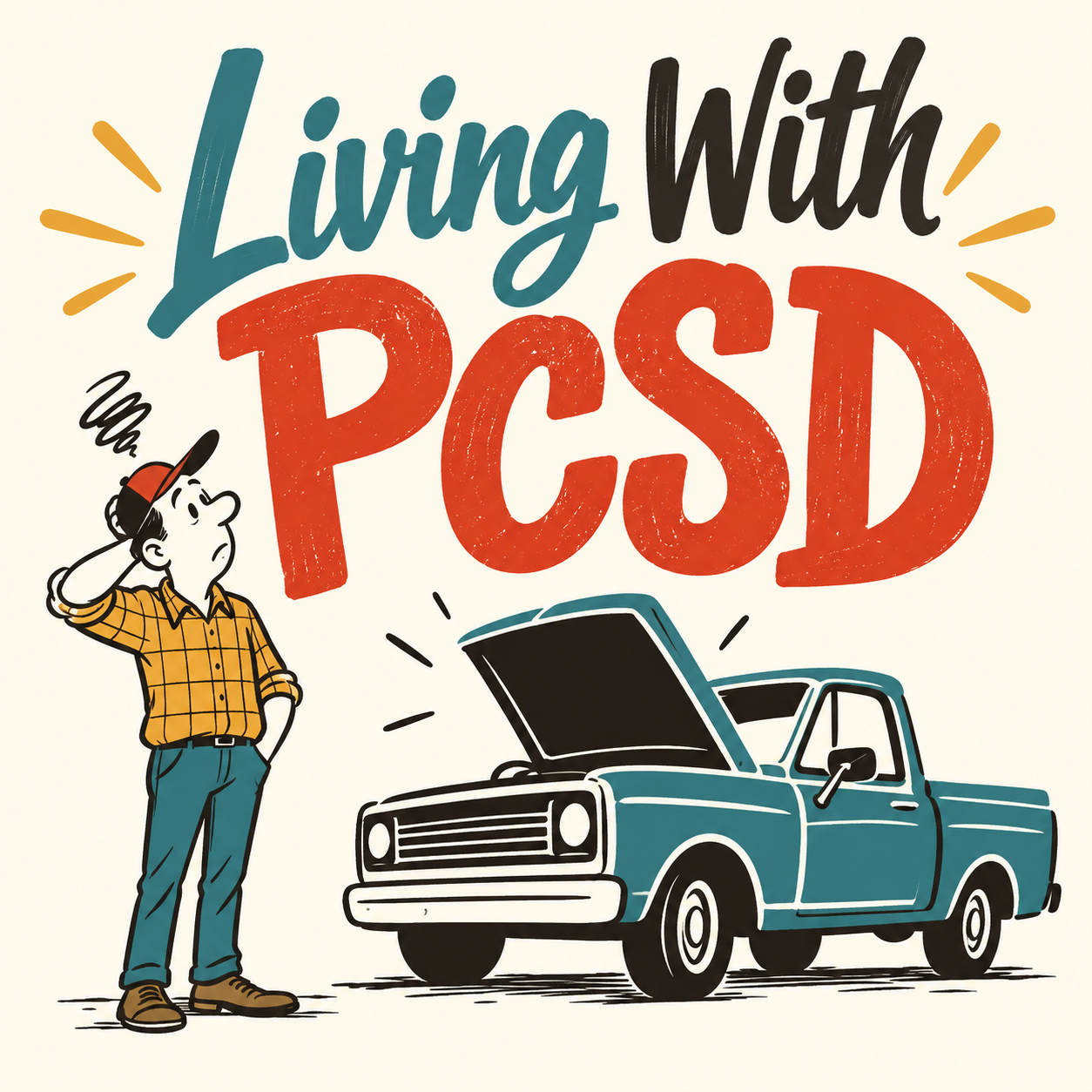
Living With PCSD
By Ricky Fitzpatrick for The Southernist
There's a troubling condition running rampant in Southern communities. And the medical community has all but dismissed it. Why, you may have suffered its debilitating effects yourself and not even known it.
Consider this...
I had a dream last night. You could say it was a nightmare, although nobody died or got chased by a dog. But it was mortifying, nonetheless.
In my dream, I got in my truck. I believe I was at the QT.
On a side note, I think the correct way to reference QuikTrip is to say "QT," but for our family, we like the feel of "the QT." Similarly, every business is preceded by a "the," as in "the Walmart" or "the Kroger." But I digress.
I was at the QT, got in the truck, and it wouldn't start.
Now that, in itself, is no strange event. My truck has a mind of its own when it comes to starting, and sometimes it fires right up, but sometimes it's a little ornery.
So, at this point, the dream is just a rehashing of typical events. But then, as dreams so often do, things started going a little wonky.
Inexplicably, I started rolling backward out of my parking spot, into the very crowded parking lot. Somehow, I steered between vehicles, all while realizing how close together we were. I mean, I was just inches away from cars on both sides.
At this point, I remember feeling the claustrophobia kicking in. There were cars everywhere, pulling in, pulling out, everyone in a rush to get somewhere. You know...a normal Tuesday. And remember, in the midst of the building chaos, my truck is still not running. And when I reach for the key and turn the switch...still nothing.
And it’s now that I begin to panic. Not because some serial killer was following me with a butcher knife or chainsaw. There was no impending doom. But I could feel, and as I type this, I feel again, the anxiety rise in my throat.
Why?
It's because of a condition that I call PCSD.
Presumptive Condemnation Social Disorder.
A Southern psychological phenomenon characterized by acute situational anxiety arising from the reasonable expectation that an otherwise ordinary, unfortunate, or embarrassing public occurrence will provoke a series of unsolicited assumptions regarding one’s character, personal responsibility, and spiritual condition.
In other words, if something embarrassing happens to you in public, south of the Mason-Dixon, it could ruin your life.
Now, that may seem a bit dramatic, but let's not forget where we are.
Southerners are among the first people to offer help when you're in trouble. Unfortunately, they're also among the first to develop an elaborate explanation for why you got yourself into trouble in the first place.
Take, for instance, a hypothetical fellow whose truck similarly won't start in the church parking lot.
To the untrained observer, this is simply a mechanical inconvenience. Perhaps a dead battery. Maybe a faulty starter. Nothing that a set of jumper cables and a mechanically inclined deacon couldn't remedy.
But to the seasoned Southern observer, there are deeper issues at work.
Why hasn't he maintained that truck properly? Is he having financial difficulties? Has he been neglecting his responsibilities? Is there trouble at home?
Before the hood is even raised, somebody has diagnosed his finances, questioned his stewardship, and added his name to the Wednesday night prayer list.
By Sunday, there may be talk of an intervention.
Possibly a laying on of hands.
And that's the trouble with PCSD. It isn't necessarily what happens to you that causes the anxiety. It's what everybody else is going to decide it means about you.
A declined debit card at the grocery store isn't merely a banking inconvenience. It's evidence of financial instability.
A child throwing a tantrum in a restaurant isn't simply a toddler pitching a fit. It's a reflection of your parenting skills, a lack of discipline, and possibly the decline of Western civilization.
And heaven forbid you show up at church wearing the same outfit you wore last Sunday. You might as well have arrived barefoot, carrying a bottle of whiskey and a copy of the National Enquirer.
The condition is particularly prevalent in small towns, where your reputation isn't something you possess so much as something the community maintains on your behalf.
And they're mighty particular about keeping it up to date.
The symptoms of PCSD vary from person to person, but they generally include excessive self-explanation, involuntary apologizing, anticipatory embarrassment, and an overwhelming desire to leave the premises before somebody recognizes you.
You may find yourself offering detailed explanations to complete strangers who haven't asked for one.
But you can't help yourself.
You're not just defending your truck.
You're defending your character. And possibly your salvation.
Southerners have developed a peculiar cultural habit of assigning moral significance to otherwise meaningless circumstances.
Sometimes a dirty house is just a dirty house.
Sometimes a crying child is just a crying child.
And sometimes a truck that won't start is just a truck that won't start.
Sometimes you just need a new battery.
Which brings me back to my dream…
I eventually woke up, relieved to discover that I was safely at home, my truck was still parked outside, and nobody had witnessed my imaginary automotive catastrophe.
But the anxiety lingered.
And I realized something.
In my dream, nobody actually said anything about me. All those judgments, all that condemnation, all that imagined damage to my reputation...I'd supplied every bit of it myself.
Which may be the most troubling symptom of PCSD.
After enough years of worrying about what everybody else might think, you eventually learn to do their judging for them.
And you get remarkably good at it.
So, the next time you see somebody struggling with a dead battery, a crying baby, or a wardrobe malfunction, do them a favor.
Offer a little help. Show a little grace. And resist the temptation to draw conclusions about the condition of their immortal soul.
They may already be suffering from a severe case of PCSD.
And the last thing they need is for somebody to confirm their diagnosis.
# # #